Process
From a drawing to a needle path to a finished back. Every step below is either something we did or something the machine did, in order.
01 / 12
The embroidery
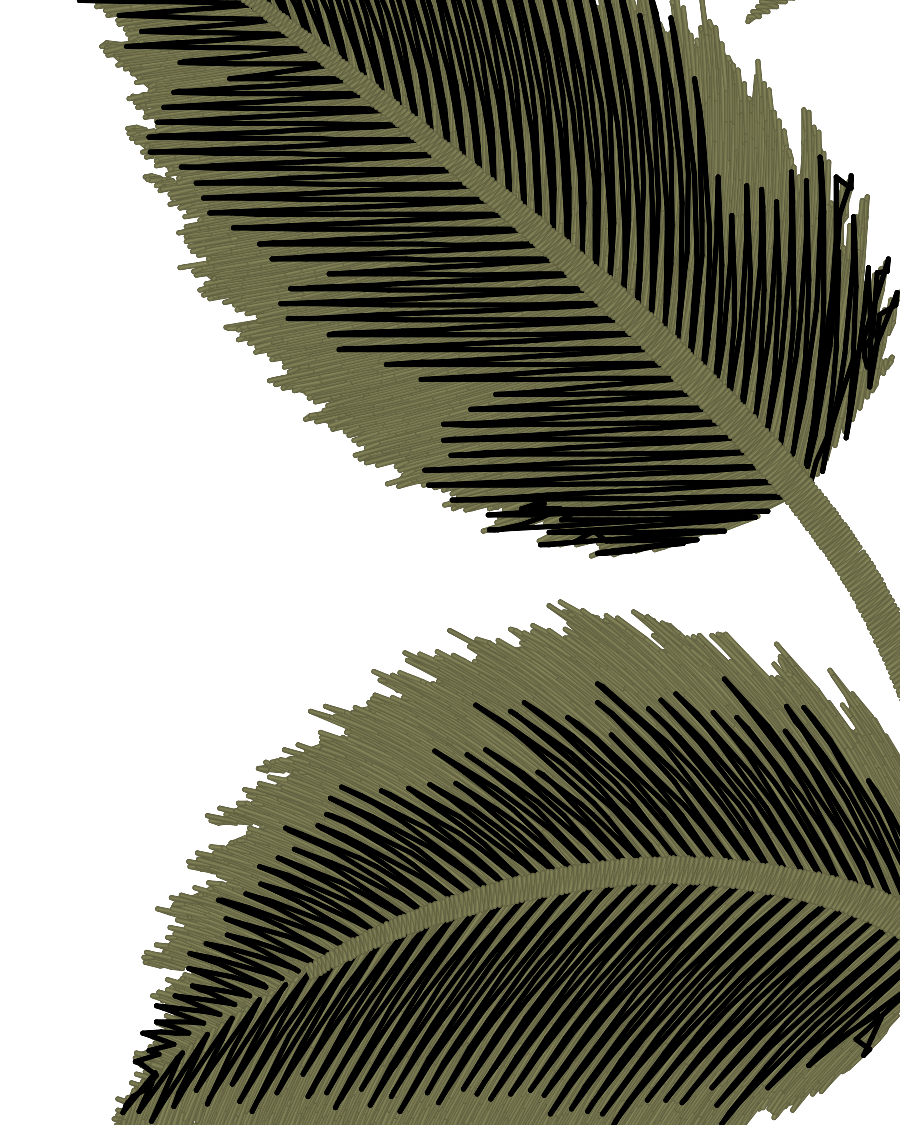
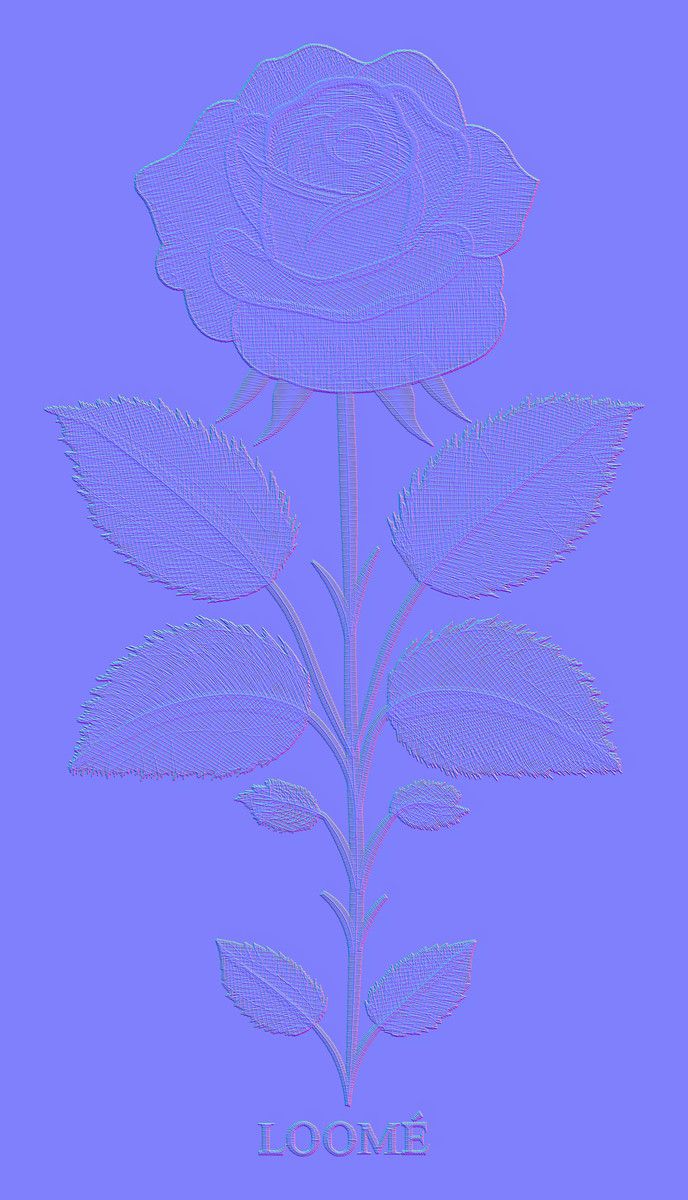
The rose is embroidered, not printed. Thread is pulled through the cloth and locked on the other side, so the artwork has depth you can feel with your thumb. A print is a layer laid on the surface instead.
02 / 12
The digitising
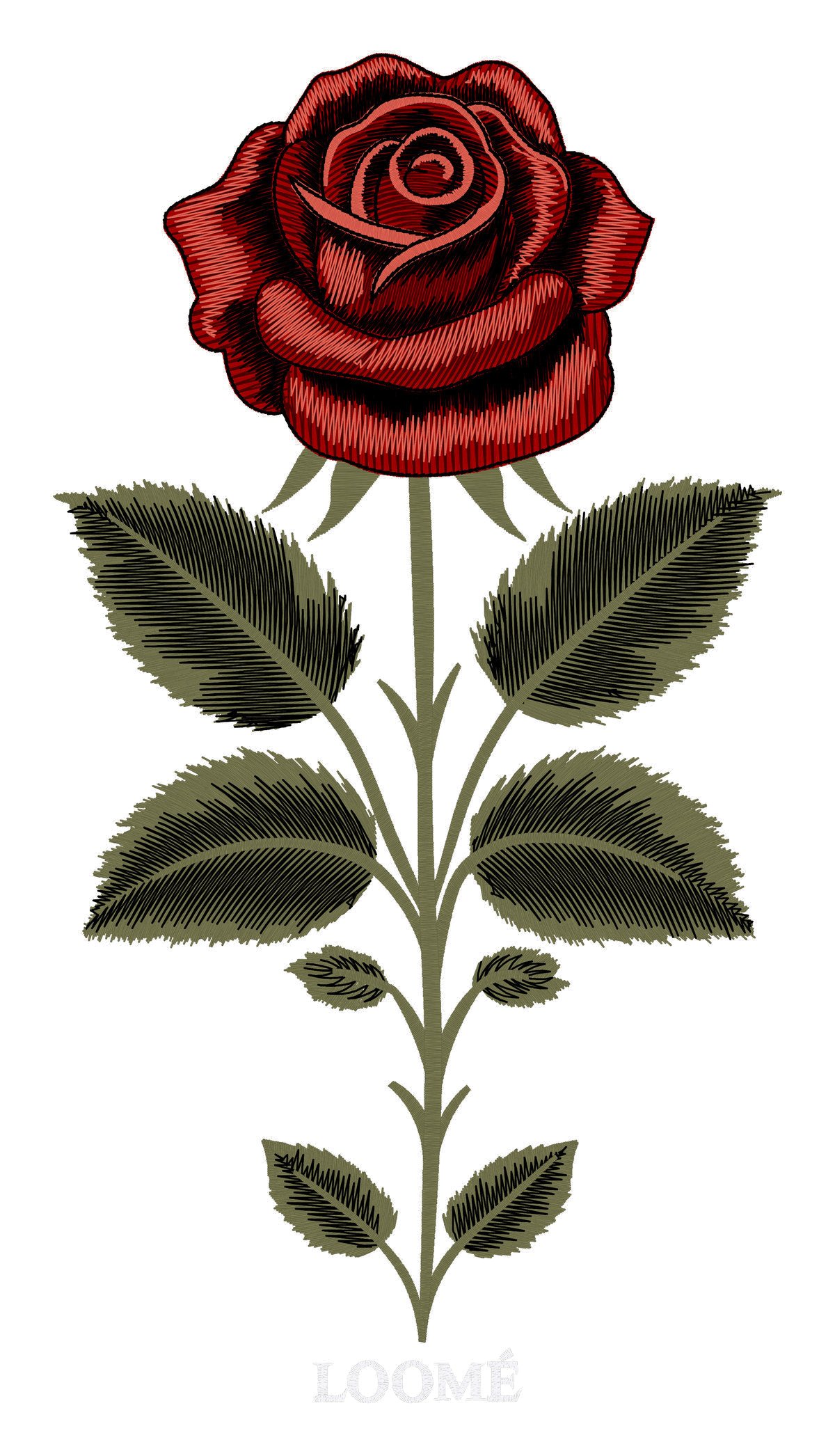
A drawing cannot be sewn as it is. It has to be digitised: every petal, leaf and highlight redrawn as a stitch type, a direction and an order of work. That decision set is what makes the rose read as a rose from six metres away.
03 / 12
The file
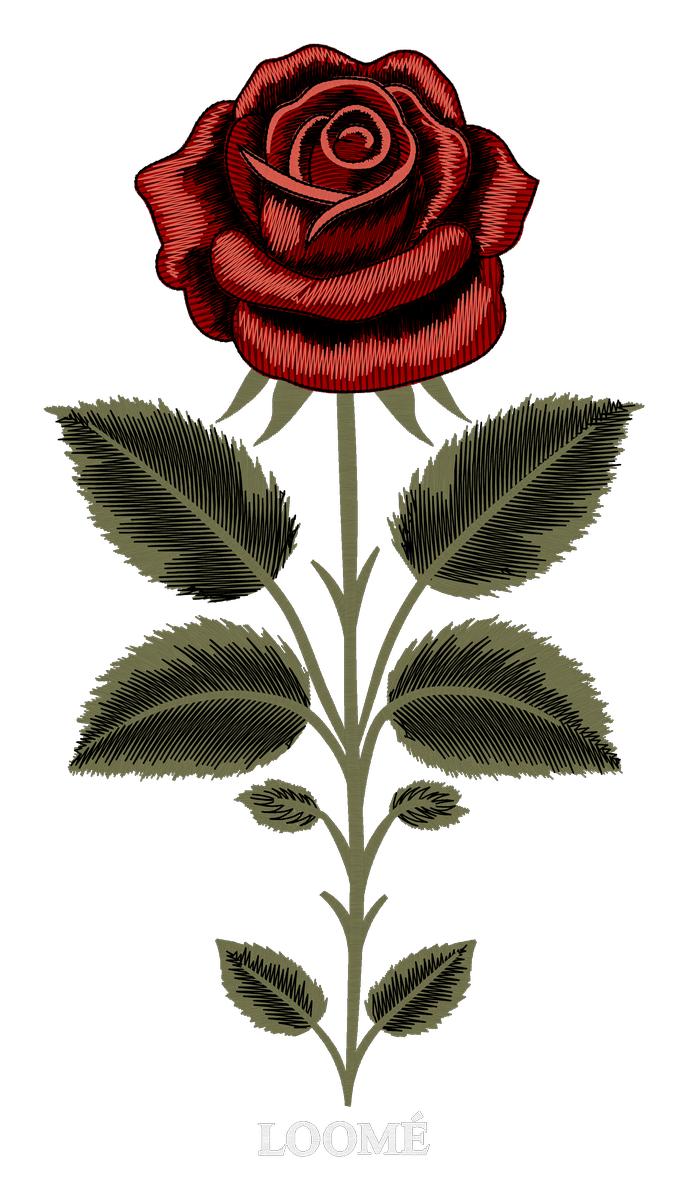
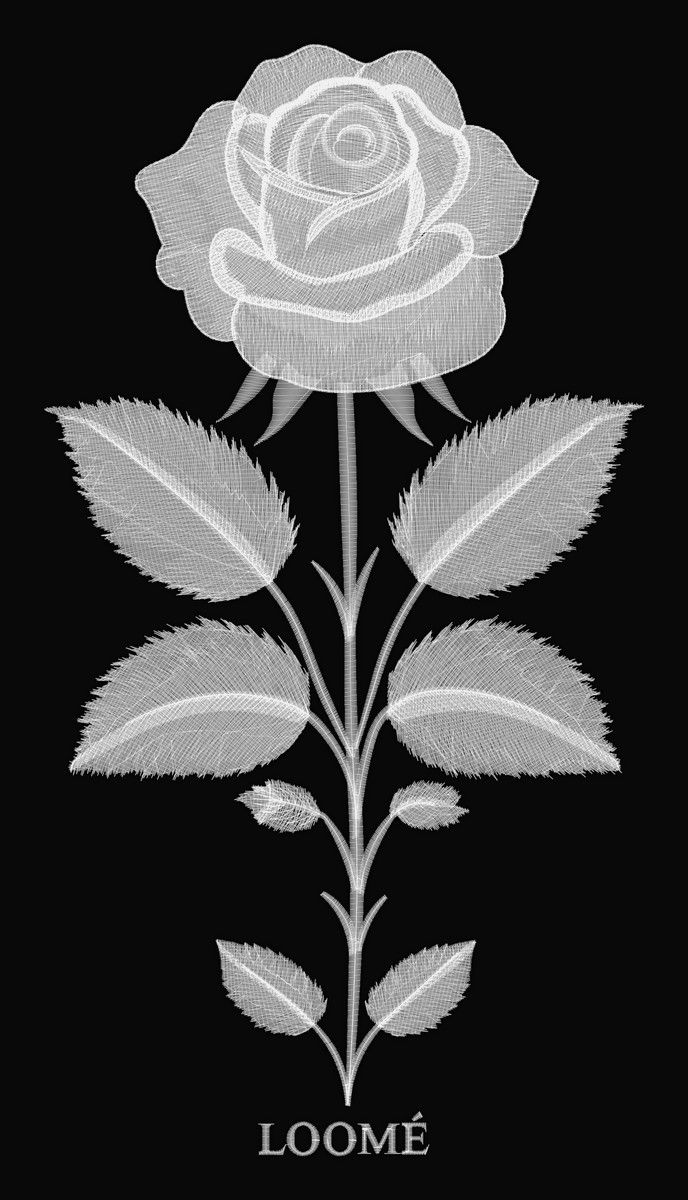
The finished file counts 73,525 stitches over 164.6 by 305.2 millimetres, with six thread colours and a fixed order of colour changes. It was signed off on the production sheet dated 21 December 2024.
01 / 03
73,525 stitches
04 / 12
The needle path
The file, drawn in the order the machine sews it. Khaki leaves first, the wordmark last. Drag the thread and watch.
Drag to sew.
26,35073,525Stitches
Block 01 / 18Block 18 / 18KhakiWhite
Page Up and Page Down move one colour block. The arrow keys move one step.
JavaScript is off, so the rose is shown finished.
05 / 12
The thread
Six colours build the rose: the deep red of the outer petals, two lighter reds and a white highlight in the bloom, and two greens in the stem and leaves. LOOMÉ is stitched under the stem in the lightest of them.
6 thread colours
420 metres of thread
Total thread from the production sheet of 21 December 2024: 1,380 feet, about 420 metres, bobbin thread not included.
The 18 colour blocks, in sewing order
| Block | Thread | Hex | Stitches | Starts at |
|---|---|---|---|---|
| 01 | Khaki | #74744E | 26,369 | 1 |
| 02 | Black | #000000 | 4,957 | 26,370 |
| 03 | Khaki | #74744E | 6,480 | 31,327 |
| 04 | Red | #AA0000 | 11,029 | 37,807 |
| 05 | Dark Red | #4A0000 | 1,828 | 48,836 |
| 06 | Black | #000000 | 3,226 | 50,664 |
| 07 | Red | #AA0000 | 2,346 | 53,890 |
| 08 | Dark Red | #4A0000 | 453 | 56,236 |
| 09 | Black | #000000 | 539 | 56,689 |
| 10 | Red | #AA0000 | 4,564 | 57,228 |
| 11 | Dark Red | #4A0000 | 1,094 | 61,792 |
| 12 | Black | #000000 | 1,229 | 62,886 |
| 13 | Pink | #DF5E4F | 2,086 | 64,115 |
| 14 | Red | #AA0000 | 2,561 | 66,201 |
| 15 | Dark Red | #4A0000 | 623 | 68,762 |
| 16 | Black | #000000 | 1,226 | 69,385 |
| 17 | Pink | #DF5E4F | 1,665 | 70,611 |
| 18 | White | #FFFFFF | 925 | 72,276 |
| Total | 73,200 | |||
Thread names are the manufacturer’s, printed as they appear on the production sheet.
Indices are read from the stitch file, which draws 73,200 stitch-to-stitch moves. The production sheet counts 73,525, including the ties the file does not draw.
06 / 12
The backing
Heavy jersey moves under a needle, so a stabiliser is held behind the panel while the machine works and the excess is cut away afterwards. That is why the rose sits flat instead of pulling the cloth into a bubble.
07 / 12
The silhouette
Very oversized, with the shoulder seam dropped down the arm and a balloon through the sleeve. The body is cut wide and left alone: no pouch to break the front, no drawcord to break the neckline.
08 / 12
The fabric
100% cotton at 600 gsm. Heavy cloth is harder to sew and harder to ship, and it is the only reason a garment this wide keeps a shape instead of hanging like a sheet.
600 gsm
09 / 12
The rib
The hem and the cuffs are a tight rib. They are what turn width into volume: the cloth gathers hard into the rib, the sleeve balloons above the wrist, the body blouses above the hip.
10 / 12
The hood
The hood is double layer, so it stands on its own behind the neck rather than folding flat. The body and the sleeves are a single layer of the same cloth.
11 / 12
The origin
Made in Guangzhou by the factory that sewed the samples. Photographed in Paris. Written, priced and packed from Berlin.
12 / 12
The care
Cold water, inside out, dried flat, iron kept off the rose. Heat and friction are what damage embroidery, and both are avoidable.